Water conservation is the least expensive source of water that we have because a gallon saved is a gallon that does not need to be imported or produced. We all need to do our part to use water as efficiently as possible, so this vital resource remains readily available, now and in the future.
Water-saving practices cost little to nothing to implement and the water and financial savings can be substantial. SGVMWD offers numerous programs and resources to help you conserve!
Explore the resources below to learn more about water conservation programs, rebates, grants, and water-saving practices.
Water Supply Basics in the San Gabriel Valley
First, let’s review the basics about the San Gabriel Valley’s water supply. Our water supply system includes a variety of sources of water including groundwater replenishment, imported water, reservoirs and cyclic storage, recycled water, storm water capture, and water transfers. Thus, despite developments such as record-breaking dry weather, worsening drought conditions, reduction of imported water deliveries via the State Water Project, extreme weather conditions resulting from climate change, and implementation of voluntary water use restrictions, the San Gabriel Valley has water in reserve to meet local needs for the near future, even if the drought continues.
However, it is a reality that local water supplies are lower than we would like. Another reality is individual cities, counties, the state and water companies may act to curtail frequency of watering, impose mandatory water-use restrictions and raise water rates/pricing to curtail water use. These are actions that the San Gabriel Valley Municipal Water District has no control over but that we encourage residents and businesses to follow in the towns in which their homes and businesses are located.
The San Gabriel Valley is a distinct watershed shaped by local mountains, rivers, streams and other geological formations. A major, natural source of water for the Valley is the San Gabriel River and streams, ponds, lakes, dams and reservoirs connected to it that are located either in the San Gabriel Mountains or the Valley, itself. Beneath the Valley is the Main San Gabriel Basin, the focal point of our Valley’s water supply system. The image below shows the series of dams and reservoirs within the San Gabriel Mountains that serve the Basin, as well as the San Gabriel Canyon Spreading Grounds.
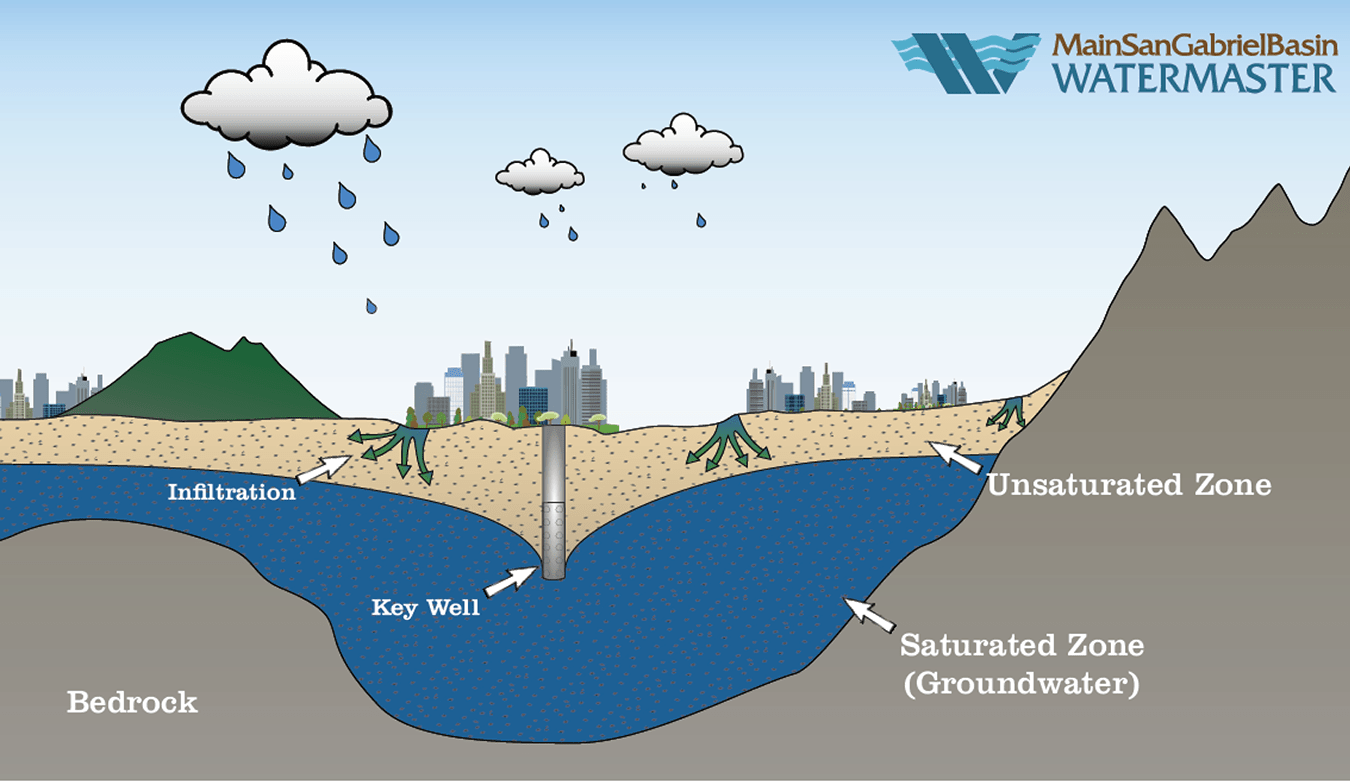
The Basin is about 100 yards below the ground, right underneath your feet, and it is underlies the Valley. Just imagine the length of a soccer or football field, but downward, deep underground. That’s where the vast majority of your water comes from. It is held in a natural holding area formed of bedrock called a water basin. This underground basin holds rainfall, snowmelt and conserved water. The illustration below simulates how a typical groundwater basin functions.
By far the largest component of local water supplies is groundwater pumping, providing about 80% of the water we use. 20% of the water we use is imported water from northern California by the State Water Project and from the Colorado River.
For more information on the Valley’s water supply, please refer to Watermaster’s educational website, “The Waters That Connect Us”.
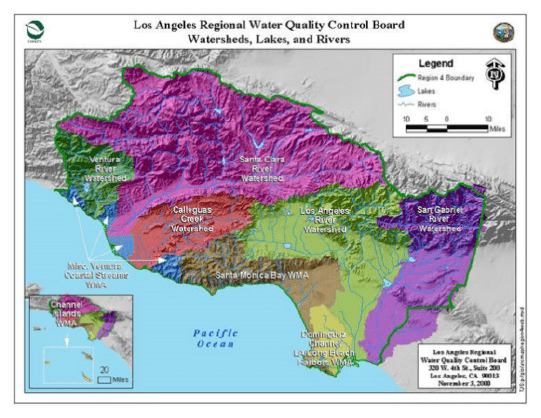
We live in the purple-colored San Gabriel River “watershed,” one of several watersheds in Los Angeles County. But we live in the Los Angeles media market. Much of the water “news” we are exposed to relates to the city of Los Angeles. However, different watersheds manage their stormwater in ways best suited to their locales. The San Gabriel Valley “water story” is unique in that 80% of the water we use is local groundwater.
Each watershed is formed by distinct topography, geology and hydrology. Decades ago, as reservoirs, dams, flood control channels, and spreading grounds were being planned, as public works and flood management personnel grappled with saving life and property, some watersheds went in the direction of building infrastructure and operating programs that “flushed” water to the ocean via storm drains as fast as possible to reduce the risk of flooding, thus, saving life and property.
Our San Gabriel River watershed was different. We, too, had to protect life and property. However, we embraced saving water for beneficial use, as well. Our region built its water infrastructure to retain and channel as much stormwater within the San Gabriel Valley as possible so it could percolate down and recharge our groundwater supplies.
Overall, the greater San Gabriel Valley captures more than 95% of stormwater, even during massive storms like we experienced earlier this year, to supplement local groundwater supplies. Data shared by the Main San Gabriel Basin Watermaster reveal that of the more than 500,000 acre-feet of stormwater captured this year in Los Angeles County, about 300,000 AF came from the San Gabriel River watershed.
Here in Southern California and the San Gabriel Valley we live in a dry, desert region. We use more water than Mother Nature provides. Supplemental sources of water (other than pumping of local aquifers or underground wells), include surface reservoir production, recycled water, storm water capture and supplies imported through wheeling arrangements or transported via aqueduct from the State Water Project and the Colorado River. When needed, the Basin holds waters we purchase from “imported” sources, such as the Sacramento-San Joaquin River Delta in Northern California and the Colorado River. Importing water is expensive and requires energy to pump it hundreds of miles. However, sometimes these imported waters are needed when rain, snowmelt and conservation aren’t enough to sustain healthy water levels in our basin. Imported water is used to fill spreading grounds which allows water to percolate or seep down to replenish groundwater.
The San Gabriel Valley Municipal Water District, formed in 1959, was created to provide a reliable supply of supplemental water for its member agencies, namely the cities of Alhambra, Azusa, Monterey Park and Sierra Madre. The District is one of 29 State Water Contractors which import water from the State Water Project, operated by the California Department of Water Resources (the District utilizes its Devil Canyon-Azusa Pipeline for this purpose).
Given the size and varied topography (mountains, foothills and valleys) of the San Gabriel Valley, it’s not surprising that groundwater levels throughout the Valley vary from location to location – different locations in the Valley have more water or more accessible water than others. And some wells in the San Gabriel Valley are polluted or contaminated. Water rights and pumping rights are complicated – for example, Monterey Park relies on water that is pumped from wells located in Rosemead. Sierra Madre draws water from the Raymond Basin while our other member cities pump water from the Main San Gabriel Basin. Thus, in 1973 the Main San Gabriel Basin Watermaster was created to manage and protect groundwater resources within the Main San Gabriel Groundwater Basin. The San Gabriel Valley Municipal Water District works very closely with Watermaster and other water agencies located in the San Gabriel Valley.
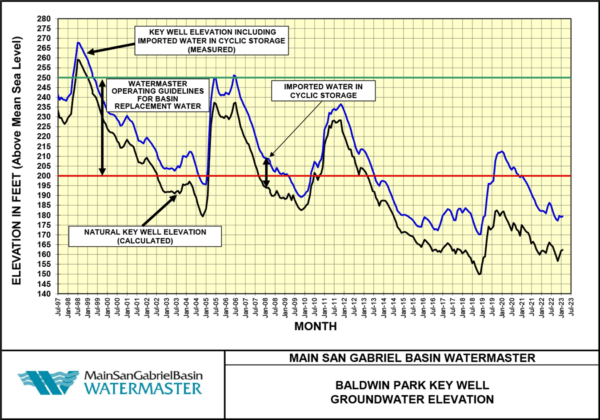
A widely accepted measure of our local groundwater supplies is the Baldwin Park Key Well. As the diagram below shows (this graph is updated on an ongoing, weekly basis), groundwater levels have longer periods of decline than of ascent given that most of our years are relatively dry, with the historic low level of 169.4 recorded in November 2019. The graph also displays the critical importance of cyclical storage: the black line indicating groundwater levels without storage and the higher, blue line indicating groundwater levels with cyclic storage factored in. Note that cyclic storage levels have increased since the last drought due to smart water management practices throughout the Main San Gabriel Basin.
Main San Gabriel Basin Watermaster updates and shows the Key Well level on its homepage each week.
 The City of Azusa draws its water primarily from Main San Gabriel Basin wells located in Azusa adjacent to spreading grounds which are located at the terminus of the pipeline operated by the San Gabriel Valley Municipal Water District. The City supplements this source of water with water from the San Gabriel River. Whenever the City’s groundwater production exceeds its water rights, untreated imported water is delivered to the San Gabriel Basin via the pipeline operated by the San Gabriel Valley Municipal Water District to replace that amount of water which was produced in excess of the City’s water rights. Water is treated, pumped to and stored in reservoirs located in the City, and then transported via the City’s water distribution system to your tap.
 Sierra Madre’s groundwater historically came primarily from wells in the Raymond Basin and from surface water that is transported via tunnels reaching into the San Gabriel Mountains. In the recent past, Sierra Madre was 100 percent reliant on its Metropolitan Water District connection due to low groundwater levels in its local wells. In 2019 the San Gabriel Valley Municipal Water District and the City of Sierra Madre worked together to identify a long-term solution to the challenges facing the City and the District. That led to a water wheeling agreement between Sierra Madre and Arcadia that also called for construction of a joint well to be located within the City of Arcadia. The water would then be transmitted through Arcadia’s existing pipelines to Sierra Madre’s water distribution system. In January 2020, the District approved nearly $1.9 million in grant funding to begin construction of the joint well.
 Monterey Park’s water comes primarily from San Gabriel Basin wells located in neighboring Rosemead. Whenever the City’s groundwater production exceeds its water rights, untreated imported water is delivered to the San Gabriel Basin via the pipeline operated by the San Gabriel Valley Municipal Water District to replace that amount of water which was produced in excess of the City’s water rights. Water is treated, pumped to and stored in reservoirs located in the City, and then transported via the City’s water distribution system to your tap.
 The City of Alhambra’s water supply is primarily groundwater pumped from a portion of the Main San Gabriel Basin which is referred to as the “The Alhambra Pumping Hole.” The City supplements this source of water with a direct connection to the Metropolitan Water District’s pipeline. Whenever the City’s groundwater production exceeds its water rights, untreated imported water is delivered to the San Gabriel Basin via the pipeline operated by the San Gabriel Valley Municipal Water District to replace that amount of water which was produced in excess of the City’s water rights. Water is treated, pumped to and stored in reservoirs located in the City, and then transported via the City’s water distribution system to your tap.
Water Conservation
The District supports water conservation for both environmental and economic reasons. Water conservation is the easiest, most efficient and least expensive means of dealing with the drought. Every drop of water saved is a drop of water that does not need to be paid for. Every drop of water we save is water that remains in our groundwater basin. Every drop of water we save is water we don’t need to import, recycle or treat.
Water Conservation means different things to different people. For some, it means equipment or processes, such as water timers and water-efficient appliances. For others, it means human behavior, such as the length of our showers, whether we install water efficient appliances, if we leave the faucet running while we brush our teeth, or if we use a hose, rather than a broom, to clean our driveways.
The Water District supports water conservation in many ways. The Conservation section of our website provides much more information on the District’s water conservation initiatives. A principle advanced by the District’s Board more than a decade ago was to develop a strong focus on educating, informing and motivating young people about water conservation. The Board believed then and now that if young people acquire water conservation and sustainability ethics, they will hold them for a lifetime and be a positive influence on their parents, families and communities.
Other informative and educational conservation-oriented websites are:
The San Gabriel Valley Municipal Water District helps students and community members learn where their water comes from, why conservation matters and how everyday actions can protect our water resources. We work with schools, nonprofit organizations and our member cities—Alhambra, Azusa, Monterey Park and Sierra Madre—to bring water education into classrooms, homes and community events.
Our educational programs and resources include:
- School presentations and assemblies: Interactive presentations introduce students to our local water supply and practical ways to conserve water. Teachers and school staff can contact the District to discuss opportunities for their students.
- Activities for school and home: Our Water Awareness Growth Chart combines water education with coloring, puzzles and other activities that help children learn about water conservation.
- Educational videos: Our Our Precious Water Resource videos and other online videos explore water supply, water quality and conservation for learning in the classroom or at home.
- Community outreach: We participate in local events and work with community organizations to share water-saving information, educational materials and opportunities to meet our conservation mascot, H₂Owl.
 Grants and regional education programs: Our Opportunities for Water Leadership (O.W.L.) Community Grant Program supports eligible school and nonprofit projects that promote water conservation and education. Through our partnership with the Public Water Agencies Group’s Conservation and Education Team (PWAG CET), teachers and students can also explore classroom grants, scholarships, educator workshops and hands-on learning programs. Visit www.pwagcet.org for program details, eligibility and application schedules.
To request a presentation, ask about educational materials or explore a partnership for your school or organization, contact the District at 626-969-7911 or info@sgvmwd.com.
Through its H2Owl Outreach Program and Speakers Bureau Program, District representatives are available to speak to schools and community and business organizations on water-related topics. We also provide tours of District facilities on a planned and requested basis. Our H2Owl mascot as well as guest speakers may be requested to appear at community events, schools and community/business meetings. When H2Owl attends events, the District usually provides free printed materials and water saving gifts. For further information or to request assistance, please contact the District.
Phone: 626-969-7911
Email: info@sgvmwd.com
What water conservation pilot projects has the District supported in member cities? Our strategy has been two-fold. First, beginning in 2009, we implemented pilot projects at highly visible, high water-consumption locations (schools, city facilities, large employers) and created partnerships with member cities and community organizations to make the pilot projects as well-known as possible. The Water District has provided approximately $12 million in grants to fund more than 25 water conservation pilot projects in our four member cities. Our goal has been both to save water and to provide information to help residents, schools, businesses and other organizations adopt water saving technology, materials and procedures for the long-term.
As “demonstration” projects, our pilot projects take place in highly visible community locations that are easy to visit and learn from. Our grants funded equipment, technology, landscaping and vegetation and promote indoor and outdoor water savings. An added objective of each grant is to foster community partnerships that involve people working together. Projects at schools and youth or community facilities typically involve youth, teachers, parents, local businesses, local non-profits, churches and school clubs. Click here to view a summary of the pilot projects.
The District’s second strategy was to incentivize non-profit schools and community/business organizations to create their own creative approaches to water conservation.
The Opportunities for Water Leadership (O.W.L.) Community Grant Program is another great resource for youth, schools and non-profit organizations. When we first introduced the Program nearly a decade ago, we offered grants ranging up to $2,000 to fund projects showing creative approaches to water education and conservation. Since 2022, grant amounts are unlimited and the streamlined application process may be completed online any time of the year. Visit our website to learn more about eligibility and our online application. See our chart that provides examples of recent grant recipients.
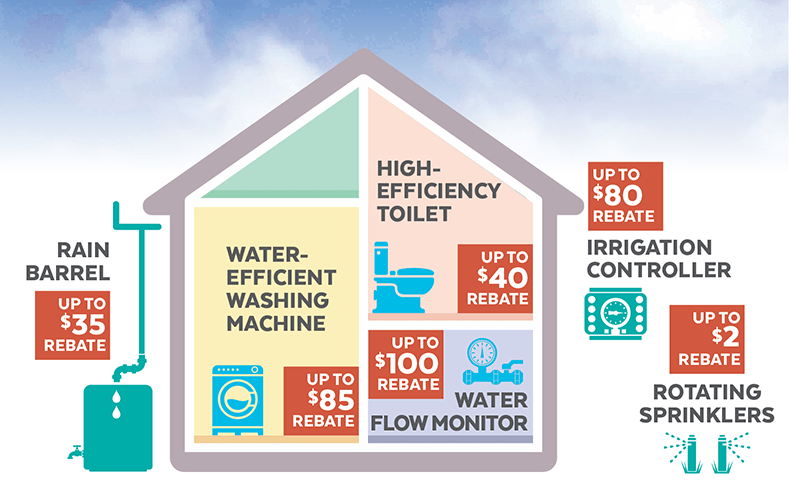
The District offers an extensive rebate program whereby stakeholders who purchase water-saving appliances and equipment save water and save money. Items in the District’s rebate program include: rain barrels and cisterns, water-efficient washing machines, high-efficiency toilets, “smart” and weather-based irrigation controllers, soil moisture sensors, rotating sprinkler nozzles and commercial waterless urinals. Apply for a rebate today!
The District offers an outdoor Irrigation Controller Retrofit Program that provides qualified residents with a FREE irrigation inspection, irrigation controller and spray nozzles. The District has contracted with EcoTech Services to manage the program. If eligible, EcoTech Services will replace your old irrigation timer with a new weather-based irrigation controller installed by a landscape professional.
Since January 2022, EcoTech has performed 257 site assessments. 236 weather-based “smart” controllers have been installed in 215 properties and 5,766 sprinkler nozzles have been upgraded to water-efficient rotating nozzles. The approximate cost/value per landscape to date is $1,136.
Saving water starts with everyday habits and a few thoughtful changes around your home, yard or workplace. The District encourages everyone to make conservation part of their daily routine, whether California is experiencing drought or a wet year. Explore our website for additional conservation resources, rebates and programs that can help you use water more efficiently.
Inside your home
- Find and fix leaks. Check faucets, toilets and pipes regularly, and repair leaks promptly.
- Turn off the tap. Avoid leaving water running while brushing your teeth, shaving or washing dishes.
- Take shorter showers. Reducing shower time is a simple way to save both water and the energy used to heat it.
- Wash full loads. Run your dishwasher and washing machine with full loads, and use water-efficient settings when available.
- Choose efficient fixtures and appliances. Look for WaterSense-labeled toilets, showerheads and faucets, and water-efficient dishwashers and washing machines when replacing older equipment.
In your yard
- Water according to need. Adjust your irrigation schedule with the seasons and weather, and turn off irrigation during rain. Follow your local water provider’s watering rules.
- Prevent runoff and overspray. Check sprinklers for leaks and broken heads, and direct water toward plants rather than sidewalks, driveways or streets.
- Water early in the morning. Cooler temperatures and lighter winds help reduce evaporation.
- Create a water-wise landscape. Choose California native and other low-water-use plants suited to your yard, and consider replacing unused lawn areas.
- Use mulch and efficient irrigation. Mulch helps soil retain moisture. Drip irrigation and weather-based controllers can help deliver water where and when plants need it.
- Sweep instead of spraying. Use a broom to clean patios, sidewalks and driveways.
More than 50% of water use occurs outdoors and that provides an abundance of opportunities for saving water. Water-wise plants and landscaping are among the smartest and most effective means of reducing outdoor water use. Over many decades, as people have relocated to southern California and the San Gabriel Valley from other parts of the country, they have tended to landscape like they did back home…beautiful landscaping, but not very water-efficient.
The reality is we live in an arid desert and we use more water than Mother Nature provides. Fortunately, for those with a certain aesthetic and those who love to garden, there are plants that are “native” to southern California and the San Gabriel Valley. They will survive in our warm, dry climate, they are attractive, they use less water, and they are readily available.
Different terms to describe such vegetation include “California Native Plants”, water-efficient plants and drought-tolerant plants. Water-efficient landscaping may also include “hardscapes” such as rock gardens, boulders, benches, synthetic turf and other decorative elements that use no water at all.
With the assistance of the California Native Plant Society’s website and its Garden Planner tool, the District has developed custom plant selection guides for each of our member cities. You, too, may utilize the Garden Planner tool with downloadable/printable tips on how to plant a Native Plant garden in Alhambra, Azusa, Monterey Park and Sierra Madre. In addition to plant recommendations, we’ve identified nurseries and gardening stores that specialize in native plants.